The White Monastery is a Coptic Christian monastery near Sohag in Upper Egypt, officially known as the Monastery of Saint Shenouda the Archimandrite. Built in the 4th century CE from white limestone blocks in a fortress-like basilica style, it was founded by Saint Shenouda and once housed thousands of monks and nuns. The site remains an active place of worship today.
Key Takeaways
- Officially named the Monastery of Saint Shenouda the Archimandrite, after the monk who founded it in the late 4th century CE.
- Built from white limestone blocks similar to those used in ancient pharaonic temples; the surviving walls date to the 5th century.
- Located about 8 kilometers northwest of Sohag, in Upper Egypt.
- Paired with the nearby Red Monastery, a few kilometers away, forming one of Egypt’s best-known sets of early Coptic architecture.
- Still an active monastery where monks maintain their traditions of worship and prayer.
History and Founding
The monastery was founded by Saint Shenouda the Archimandrite in the late 4th century CE, one of the most influential figures in early Egyptian monasticism. Under his leadership the community grew to house thousands of monks and nuns, and the White Monastery became a spiritual, educational, and cultural center where theological texts were written, translated, and preserved.
Architecture
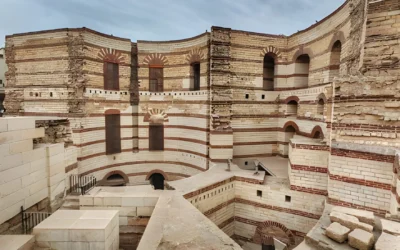
The monastery’s church resembles a fortress. Its massive limestone walls, dating to the 5th century, are adorned with faded but still visible reliefs and inscriptions. Inside, the basilica layout blends Roman and Egyptian styles, with an expansive nave, side aisles, and an apse that retains remnants of early Christian frescoes. The church once held manuscripts that are now preserved in museums around the world.
The design invites comparison with the Red Monastery, located a few kilometers away. Together, the two monasteries represent the height of early Coptic architecture and religious devotion.
Visiting Today
The White Monastery continues to function as an active religious site where monks maintain their ancient traditions of worship and prayer. It sits in a desert landscape similar in mood to the White Desert or Mount Sinai (Jebel Musa), both known for the same sense of stillness that drew monks to settle there.
Visitors often combine the White Monastery with other Christian heritage sites such as the Hanging Church in Cairo, Coptic Cairo (Old Cairo), or St. Catherine’s Monastery, along with sites from other faiths such as the Ben Ezra Synagogue and the pharaonic Temple of Seti in Abydos.
Getting There
The White Monastery is reached from the city of Sohag, about 8 kilometers away, via road, in Upper Egypt. It’s often combined with nearby sites like the Red Monastery or included in wider itineraries through Upper Egypt, such as Egypt Vacation Packages covering cultural, historical, and spiritual landmarks, or a Cultural Tours Egypt itinerary focused on Coptic and early Christian history.
Some itineraries pair it with Luxor and Aswan highlights such as the Nile River and the Valley Of The Kings, a 14 day Egypt tour, an Egypt adventure tour, or a private guided tour of Egypt. Travelers exploring Egypt’s desert oases sometimes extend the trip to Kharga Oasis or Dakhla Oasis.
Preservation
The White Monastery has survived centuries of environmental wear and human intervention. Restoration projects led by local and international experts have helped stabilize the structure and preserve its artwork, and continue to reveal details about its construction methods, inscriptions, and the daily life of the monks who lived there.
It sits alongside other icons like the Great Pyramids Of Giza and Abu Simbel Temples as part of Egypt’s layered religious history, and is often described as one of the country’s Hidden Gems In Egypt.
FAQs about the White Monastery in Egypt
Where is the White Monastery located?
The White Monastery is situated near Sohag in Upper Egypt, approximately 8 kilometers northwest of the city center. It’s often visited alongside the nearby Red Monastery.
Who founded the White Monastery?
Saint Shenouda the Archimandrite founded the monastery in the 4th century CE. Under his leadership, it became one of the most influential monastic communities in the Coptic world.
What is unique about the architecture of the White Monastery?
The monastery is built from white limestone, giving it its name. Its design combines Roman basilica elements with traditional Egyptian masonry, creating a fortress-like appearance that remains remarkably well-preserved.
Can tourists visit the White Monastery today?
Yes. The site welcomes visitors regularly and remains an active place of worship. Guided tours provide insights into its history, art, and restoration.
What are other nearby attractions worth visiting?
Travelers often pair the White Monastery with the Red Monastery, and with historical sites in Upper Egypt such as the Temple Of Seti and Dandara Temple.