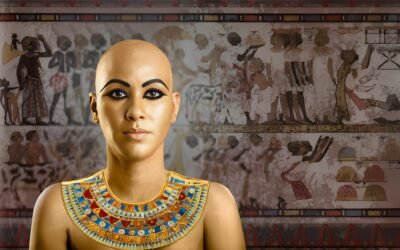
Nefertiti was the Great Royal Wife of Pharaoh Akhenaten, ruling alongside him during Egypt’s 14th century BCE Amarna Period. Her name translates to “the beautiful one has come.” She took an active role in religious and political life as Akhenaten shifted Egypt’s worship toward the sun god Aten, and some scholars believe she may have ruled independently after his death under the name Neferneferuaten.
Key Takeaways
- Great Royal Wife of Pharaoh Akhenaten, active during Egypt’s 14th century BCE Amarna Period.
- Her name translates to “the beautiful one has come.”
- Akhenaten and Nefertiti moved Egypt’s capital to Amarna, near modern El Minya, to worship the sun god Aten.
- The Nefertiti Bust, discovered at Amarna in 1912, now resides in a museum in Berlin.
- Some scholars believe she may have ruled Egypt independently after Akhenaten’s death under the name Neferneferuaten.
Nefertiti and the Amarna Period
Nefertiti lived during the 14th century BCE, a transformative era in ancient Egypt. As the Great Royal Wife of Pharaoh Akhenaten, she was part of a rule that abandoned traditional Egyptian polytheism in favor of worshipping Aten, the sun disk. The couple relocated Egypt’s capital to Amarna, near modern El Minya, where they built a new religious center dedicated to Aten. Visitors today can see remnants of this at Tell El Amarna Egypt, where temples, palaces, and private tombs still bear traces of Nefertiti’s image.
Her Role in Religion and Politics
Temple carvings show Nefertiti taking an active part in royal ceremonies, religious rituals, and military displays, standing beside Akhenaten as an equal — a rare position for a consort in ancient Egyptian society. Her statues and reliefs also mark a shift in Egyptian art, from rigid formal depictions toward more natural, intimate portrayals of the royal family. Examples of this Amarna-period art, including fragments of statues believed to depict Nefertiti and Akhenaten together, are held at The Egyptian Museum Of Cairo.
Disappearance and the Nefertiti Bust
Nefertiti disappears from historical records around the 12th or 13th year of Akhenaten’s reign. Some theories hold that she died, while others propose she changed her name and ruled as pharaoh under the name Neferneferuaten. The Nefertiti Bust, discovered at Amarna in 1912, is now held in Berlin and remains one of the best-known examples of ancient Egyptian craftsmanship.
Sites Connected to Nefertiti and the Amarna Period
At Luxor City, the Temple Of Hatshepsut honors another powerful female ruler who preceded Nefertiti’s reign. The Tomb Of Nefertari holds some of the best-preserved wall paintings of any royal woman’s tomb in Egypt. A cruise on The Nile River, including one of the Best Nile River Cruises, passes landscapes similar to those Nefertiti and Akhenaten would have traveled. Curated Famous Egyptian Queens tours cover Nefertiti alongside Hatshepsut and Cleopatra, and exhibits of Ancient Egyptian Papyrus Art and Real Ancient Egyptian Artifacts show the craftsmanship produced for her court.
Visiting These Sites
These sites can be explored through general Egypt Tour Packages, an Egypt tour with Nile cruise, or a customized best Egypt itinerary. A luxury Egypt tour package can pair private guides with in-depth coverage of the Amarna Period, and a sailing on the Queen Nefer Dahabiya follows the Nile in the style Nefertiti’s family once traveled. Related reading includes Was Pharaoh Akhenaten The Rebel King Who Changed Egypt Forever? and The King Tutankhamun’s Mask, which trace the family line from Nefertiti and Akhenaten to their probable son, Tutankhamun. Family and private itineraries, including Egypt family tour holidays and a private guided tour of Egypt, can also be built around these sites.
FAQs About Queen Nefertiti
Who was Queen Nefertiti?
Queen Nefertiti was the Great Royal Wife of Pharaoh Akhenaten and one of ancient Egypt’s most powerful and influential queens. She is remembered for her beauty and for playing a key role in Egypt’s religious transformation.
Where was Queen Nefertiti’s capital?
Queen Nefertiti and Akhenaten moved Egypt’s capital to Amarna, located near modern El Minya. The city was dedicated to Aten, the sun disk, symbolizing their monotheistic beliefs.
What happened to Queen Nefertiti?
Her fate remains a mystery. Some theories suggest she died, while others propose she ruled as a pharaoh after Akhenaten’s death under the name Neferneferuaten.
Where can I see artifacts related to Nefertiti?
Artifacts connected to Nefertiti can be admired at The Egyptian Museum Of Cairo and other historical sites across Egypt, especially in the Amarna region.
How can I explore sites related to Queen Nefertiti?
Travelers can explore her legacy through curated tours such as Egypt adventure tour or luxury options like a luxury holiday tour Egypt, which include visits to ancient temples, tombs, and artifacts linked to her era.