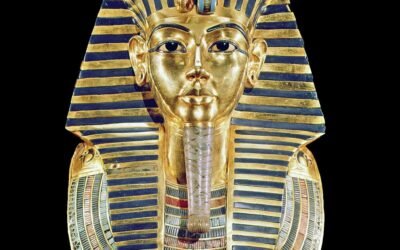
The King Tutankhamun’s Mask is a solid-gold funerary mask weighing over 10 kilograms, made more than 3,300 years ago during Egypt’s 18th dynasty and discovered in 1922 by Howard Carter in the young pharaoh’s tomb in the Valley of the Kings. It is inlaid with lapis lazuli, glass, obsidian, and quartz, and is now displayed in the Tutankhamun Galleries of the Grand Egyptian Museum in Giza.
Key Takeaways
- Discovered in 1922 by Howard Carter in Tutankhamun’s tomb in the Valley of the Kings.
- Made of solid gold weighing over 10 kilograms, crafted more than 3,300 years ago during Egypt’s 18th dynasty.
- Inlaid with lapis lazuli, colored glass, obsidian, and quartz among other semi-precious stones.
- Hieroglyphic inscriptions on the shoulders invoke protective deities, and the back carries a passage from the Book of the Dead, the sacred text meant to guide the soul through the afterlife.
- Currently displayed in the Tutankhamun Galleries of the Grand Egyptian Museum in Giza, together with the other treasures from the tomb.
Discovery in the Valley of the Kings
The mask was found in 1922 when Howard Carter uncovered Tutankhamun’s nearly intact tomb in The Valley Of The Kings, one of the most significant archaeological discoveries of the 20th century. The tomb held thousands of objects meant to accompany the young pharaoh into the afterlife; the mask itself was placed directly over the mummy’s head and shoulders.
Craftsmanship and Materials
The mask is made primarily of solid gold, weighing over 10 kilograms, and was created more than 3,300 years ago during Egypt’s 18th dynasty. Its inlays include lapis lazuli — used for the blue stripes on the headdress that signal royalty — along with colored glass, obsidian, and quartz. Similar craftsmanship can be seen among the wider collection at The Egyptian Museum Of Cairo.
Hieroglyphic inscriptions on the mask’s shoulders invoke protective deities, imagery connected to the broader system of Ancient Egyptian Animal Gods. The back of the mask carries a passage from the Book of the Dead, a sacred text meant to guide the soul through the afterlife.
Symbolism
The mask’s nemes headcloth (the pharaoh’s striped head covering), ceremonial beard, and inlaid eyes represent Tutankhamun’s transformation into Osiris, the god of the afterlife. In ancient Egyptian belief, gold represented the flesh of the gods, which is why it was the material chosen for a king’s funerary mask. The design reflects Ma’at, the Egyptian concept of everlasting harmony and order. Sites tied to this belief system include the Karnak Temple and Luxor Temple, where pharaohs were honored as intermediaries between gods and people.
Where to See It Today
The royal mummies are shown at The National Museum Of Egyptian Civilization, while the mask itself, with the rest of the treasures from the tomb, is on display in the Tutankhamun Galleries of The Grand Egyptian Museum. Since its discovery, the mask has also traveled internationally, appearing in exhibitions from London to Los Angeles.
Tutankhamun’s tomb (KV62) in the Valley of the Kings still holds the stone sarcophagus and replicas of the mask and inner coffins, even though most original treasures have been relocated to museums.
Nearby Sites From Tutankhamun’s Era
A trip built around Tutankhamun’s world typically starts in Luxor City, once the heart of ancient Thebes and the gateway to the Valley of the Kings, with stops at the Temple Of Hatshepsut and the Colossi Of Memnon. The same era’s artistry and symbolism also appears in Ancient Egyptian Papyrus Art. A cruise along The Nile River or one of the Best Nile River Cruises connects these sites.
Tours That Include These Sites
Options range from a 4 day Egypt tour to a 14 day Egypt tour, an Egypt adventure tour, an Egypt tour with Nile cruise, a luxury Egypt tour package, or Cultural Tours Egypt, several of which combine Cairo City museums with a trip down the Nile. Curated Egypt Vacation Packages can build a trip around seeing the mask and related sites.
FAQs About The King Tutankhamun’s Mask
Where is The King Tutankhamun’s Mask located today?
The mask is displayed in the Tutankhamun Galleries of the Grand Egyptian Museum in Giza, which are included in standard admission.
What materials were used to create the mask?
The mask is solid gold inlaid with colored glass, obsidian, lapis lazuli, quartz, and other semi-precious stones, materials that represented divine and protective qualities in ancient Egyptian belief.
Why is The King Tutankhamun’s Mask so important?
It represents the height of ancient Egyptian funerary artistry and offers insight into royal burial customs, spiritual symbolism, and craftsmanship during Tutankhamun’s reign.
Can visitors see the original mask in Egypt?
Yes. The original mask can be seen in Cairo and is a centerpiece of many Egypt Tour Packages.
What other attractions should I visit to learn about Tutankhamun’s era?
The Valley Of The Kings, Luxor Temple, and Karnak Temple round out a visit focused on Egypt’s New Kingdom and Tutankhamun’s time.