Hatshepsut For Beginners: The Woman Who Ruled As Pharaoh
Hatshepsut was a woman who ruled ancient Egypt as a full pharaoh during the 18th Dynasty, in the New Kingdom, after first serving as regent for her young stepson Thutmose III. She governed for about two decades, sent a famous trading expedition to Punt, and built the terraced mortuary temple at Deir al-Bahari, opposite Luxor, which visitors can still enter today.
Key Takeaways
- Hatshepsut began as regent for Thutmose III, then took the full royal titles and ruled as pharaoh, often shown in male regalia with the traditional false beard.
- Her mortuary temple at Deir al-Bahari, on the west bank of the Nile at Luxor, is open daily from 06:00 AM to 05:00 PM, per the Ministry of Tourism and Antiquities.
- Foreign adult ticket prices for the temple are published differently by two official sources (EGP 360 and EGP 440), so check before you go.
- The temple is best known for its three colonnaded terraces and for reliefs recording the trade expedition to the land of Punt.
- Later damage to her statues and images is often linked to attempts to erase her memory, though historians still debate the exact motive.
Who Was Hatshepsut?
Hatshepsut was the daughter of Thutmose I and the principal wife of her half-brother Thutmose II. When Thutmose II died, his heir, Thutmose III, was still a small child, so Hatshepsut stepped in as regent, meaning a person who governs on behalf of a ruler too young to rule. Within a few years she did something unusual: she adopted the full titles of a king. Egypt had seen powerful queens before, but a woman holding the actual throne with the formal royal titulary was rare.
For a beginner, the useful way to picture her is as a capable administrator rather than a usurper in a dramatic sense. Her reign was stable, prosperous and focused on construction and trade. She belonged to the early New Kingdom, the period when Egypt expanded its influence and began building on a grander scale at Karnak and across the Theban region.
How a Woman Became Pharaoh
Egyptian kingship was tied to the idea that the king embodied the god Horus and upheld ma’at, the principle of cosmic order and balance. There was no law forbidding a woman from ruling, but the ideology was built around a male ruler. Hatshepsut resolved this by legitimising herself through divine and family claims. Inscriptions at her temple present her as the chosen child of the god Amun, with scenes of her divine birth, and they stress her royal father’s wish that she succeed him.
Her official image changed over time. Early statues show a recognisably female figure, while later ones present her with the king’s kilt, the nemes headcloth and the ceremonial false beard. Titles in texts sometimes mix grammatical genders. This was not an attempt to hide that she was a woman; it was the standard visual language of kingship adapted to fit her.
Her Reign: Trade, Building and Stability
Hatshepsut’s reign is remembered less for conquest than for peaceful achievement. The best-known event is the expedition to Punt, a trading region on the Red Sea whose exact location is still debated, probably somewhere in the Horn of Africa or southern Red Sea coast. Ships returned with incense trees, myrrh, ebony, gold and exotic animals. The scenes are carved in detail on the walls of her temple, and they are among the most vivid trade records from ancient Egypt.
She also restored monuments, commissioned obelisks at Karnak and invested heavily in the cult of Amun, the dominant state god of the period. Many of these projects reinforced her claim to rule by tying her to the gods and to earlier great kings. If you want a focused guide to the monument itself, this overview of the Temple of Hatshepsut covers the site in more depth.
The Temple at Deir al-Bahari
Her mortuary temple, called Djeser-Djeseru (“Holy of Holies”), sits at the foot of the limestone cliffs at Deir al-Bahari on the Theban west bank. A mortuary temple was a place where offerings were made to a king after death, separate from the tomb itself. Hatshepsut’s temple rises in three broad terraces linked by long ramps, with colonnades of square pillars and statues of the queen in the form of Osiris, the god of the afterlife.
The design was partly inspired by the neighbouring mortuary temple of Mentuhotep II from the Middle Kingdom, but it is far more ambitious, using the cliff backdrop as part of the architecture. The upper terrace holds sanctuaries, including shrines to Hathor and Anubis, and the surrounding walls carry the reliefs of the divine birth and the Punt expedition. Large parts were restored in the twentieth century, so some sections you see are reconstructions.
The Erasure of Her Image
Visitors often notice that many statues and carved images of Hatshepsut are damaged, defaced or missing. For a long time this was explained as revenge by Thutmose III, who finally ruled alone after her death. More recent scholarship has complicated that story. The damage appears to have been carried out some years after her death, possibly late in Thutmose III’s reign, and the motive may have been tied to securing the succession for his own heir rather than personal hatred.
The truth is that historians still disagree, and it is more accurate to say her monuments were targeted than to name a single cause. Some statues were smashed and buried in quarry pits near the temple, which is why museums today hold reassembled pieces. This is a good example of how much of Egyptian history is reconstructed from fragments.
Planning a Visit: Hours, Tickets and Timing
Per the Ministry of Tourism and Antiquities, the temple is open daily from 06:00 AM to 05:00 PM. The Ministry’s official ticketing service gives seasonal detail: in the summer season the site opens at 06:00 am with last entry at 05:00 pm, and in the winter season it opens at 06:00 am with last entry at 04:00 pm. These describe different periods rather than a disagreement. The ticketing service also advises arriving at least one hour before a site’s closing time.
Ticket prices need a careful note. Egyptian adults pay EGP 40 and Egyptian students pay EGP 20, per the Ministry of Tourism and Antiquities and the official ticketing service. For foreign visitors, the two official sources publish different figures: the Ministry of Tourism and Antiquities lists EGP 360 for an adult and EGP 180 for a student, while the official ticketing service lists EGP 440 for an adult and EGP 220 for a student. Because the published figures differ, confirm the current price through the official ticketing channel before travelling. All monument prices are quoted in Egyptian Pounds, and fees and hours are revised periodically.
| Ticket category | Ministry of Tourism and Antiquities | Official ticketing service |
|---|---|---|
| Foreigner, adult | EGP 360 | EGP 440 |
| Foreigner, student | EGP 180 | EGP 220 |
| Egyptian, adult | EGP 40 | EGP 40 |
| Egyptian, student | EGP 20 | EGP 20 |
Student tickets require a valid student ID, and the holder’s age must not exceed 24. Children under 6 enter free, as do certain Egyptian groups listed under the Ministry’s free-entry policy. Photography with a mobile phone is free of charge at Ministry sites.
Fitting Hatshepsut Into a Wider Egypt Trip
The temple is usually visited as part of a Luxor west bank day alongside the Valley of the Kings and the Colossi of Memnon. An early start suits the site well, since the temple sits against exposed cliffs and the terraces have little shade. Starting at the 06:00 opening gives you cooler light and fewer crowds, which also helps for photographs of the colonnades.
Travellers who want Luxor combined with the rest of Egypt often build it into a longer route. A structured option such as this 8-day itinerary with a Nile cruise links the Theban monuments with Aswan and Cairo, while a 15-day Egypt tour leaves more room to explore the temples at a slower pace.
Seeing Luxor From the Water
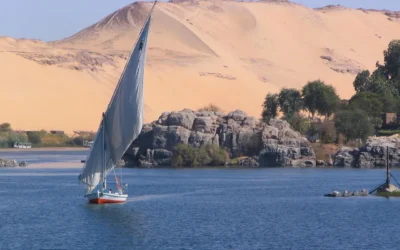
Many visitors reach the west bank from a Nile cruise moored at Luxor, where the day typically begins with a ferry or coach crossing to the temple area. Sailing between Luxor and Aswan lets you pair Hatshepsut’s temple with other major sites, such as Edfu and Kom Ombo, without repacking. If a cruise appeals, the Ms Crown Jewel Nile cruise is one example of a conventional ship option, while the Malouka dahabiya offers a smaller, slower sailing-boat style of trip.
Hatshepsut Among Egypt’s Other Rulers
Hatshepsut makes more sense when placed beside other unconventional rulers. Her stepson Thutmose III went on to become one of Egypt’s great military kings, while a later 18th Dynasty pharaoh, Akhenaten, reshaped religion itself. Reading about them side by side shows how varied royal power could be, and this piece on Akhenaten the rebel king is a natural companion. For a broader set of profiles, the pharaohs and queens section collects more rulers and royal women.
Frequently Asked Questions
Was Hatshepsut really a pharaoh or just a regent?
Hatshepsut was a full pharaoh. She began as regent for the child Thutmose III, then took the complete royal titles and ruled as king for about two decades, which is why she is shown in royal regalia on her monuments.
Where is the Temple of Hatshepsut?
It is at Deir al-Bahari on the west bank of the Nile, opposite Luxor, set against the limestone cliffs of the Theban hills. It is normally visited on the same day as the Valley of the Kings.
What are the opening hours?
Per the Ministry of Tourism and Antiquities, the temple is open daily from 06:00 AM to 05:00 PM. The official ticketing service states summer entry from 06:00 am with last entry at 05:00 pm, and winter entry from 06:00 am with last entry at 04:00 pm.
How much does a foreign visitor pay for a ticket?
The two official sources publish different figures: the Ministry of Tourism and Antiquities lists EGP 360 for an adult and EGP 180 for a student, while the official ticketing service lists EGP 440 and EGP 220. Because they differ, check the official ticketing channel before you travel.
Can students get a discount?
Yes. A student ticket requires a valid student ID, and the holder’s age must not exceed 24. Egyptian students pay EGP 20, per the Ministry of Tourism and Antiquities and the official ticketing service.
Why are so many of her statues damaged?
Many of her images were broken or removed some years after her death. It was once blamed on revenge by Thutmose III, but historians now debate the motive, with succession politics proposed as a more likely explanation.